
Shade Shed Size Guide By Industry And Application
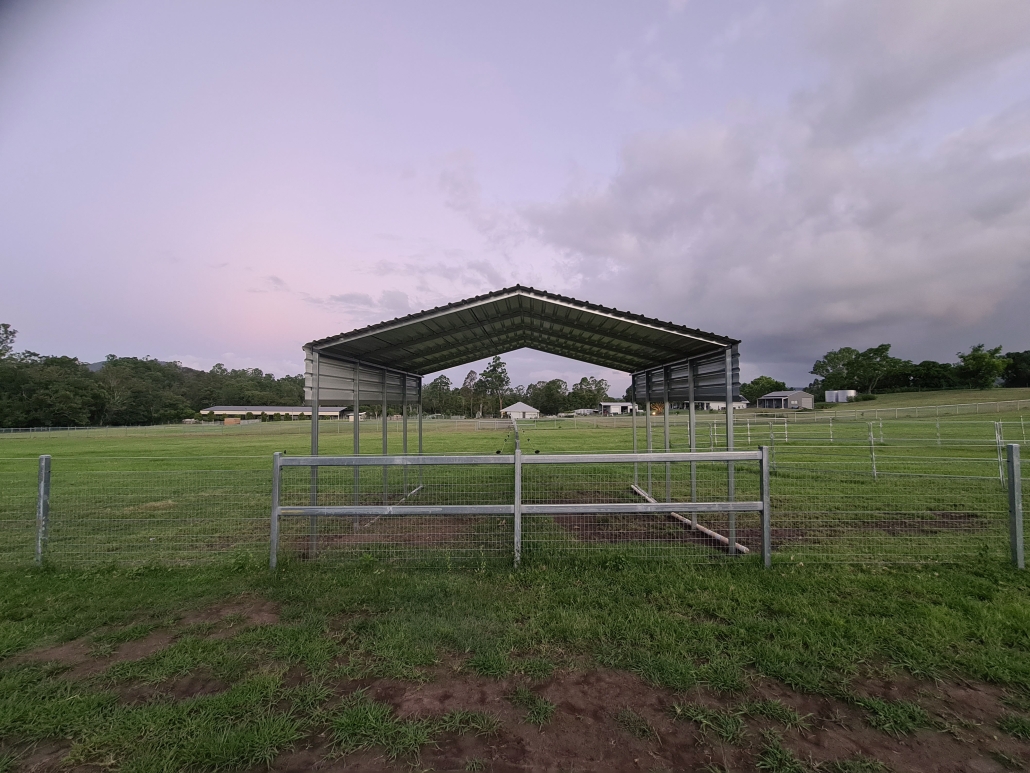
Trying to figure out what size shed you need to protect your assets? We’re here to help guide you through the process.
The quick answer: The right shade shed size depends entirely on your specific assets and how you’ll use the space. To determine what size you’ll need, first you’ll need to measure your vehicles, equipment, or livestock areas carefully, then add adequate clearance for comfortable access and future needs.
Getting your shade shed sizing right from the start will save you headaches and wasted money, and at QLD Shade Sheds, we’ve spent over a decade helping Queenslanders like you work through sizing decisions for COLORBOND® sheds and shelters. Understanding the benefits of shade sheds will help you appreciate why proper sizing matters, and this guide will help you understand what to measure and what considerations matter for different applications.
Important: This guide provides general considerations only. Any examples in this guide are illustrative, not prescriptive, and you’re responsible for measuring your specific assets and determining adequate clearance. QLD Shade Sheds provides guidance to support your decision-making, but the final sizing decision will be yours.
Understanding advertised dimensions vs internal clearance
Our advertised shed widths represent the rounded off external frame dimension, not the internal clearance you’ll have available, so when choosing the size of your shed, you’ll need to consider that the actual usable space will be less due to frame components and structural elements. Also consider that our structures feature portal spacing at 1400mm centres, and this may influence asset positioning.
How to measure your space requirements
Measure your assets at their widest, longest, and tallest points:
- Include trailers, not just the asset itself
- Account for mirrors, antennas, roof racks, and attachments
- Measure equipment with all implements attached
- For boats, measure on the trailer with protruding hardware
Determine your clearance needs for:
- Comfortable walking space around your assets
- Vehicle door opening/swing space
- Manoeuvring in and out
- Future upgrades
Add your asset dimensions and required clearance together to determine minimum shed size.
Vehicle storage considerations
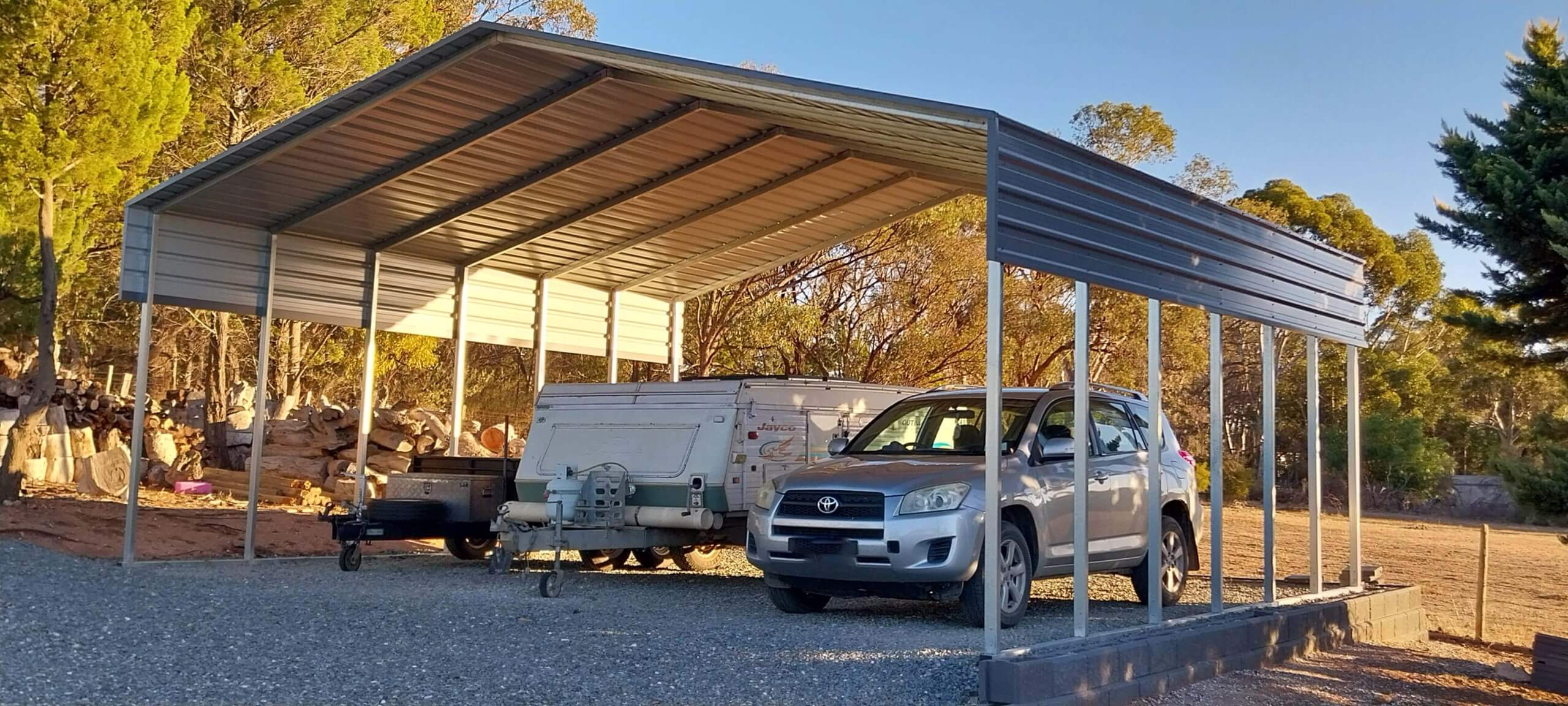
Vehicle sizes vary enormously. Measure your specific vehicle’s width, length, and height, then account for door swing on both sides. Also ensure that your measurements include side mirrors, bull bars, roof racks, and any accessories that protrude.
For multiple vehicles, measure each individually and calculate total width needed including clearance between vehicles, noting that modern dual-cab utes and large 4WDs are typically wider than older sedans.
Boats and marine equipment sizing
Boat dimensions vary dramatically, and trailers often add significant width beyond the boat’s beam. Measure your boat beam at its widest point, overall length including outboard motor, height including towers or aerials, and trailer width (which often exceeds boat beam).
Note here that tinnie sizes differ vastly from cabin cruisers, so measure your specific boat and trailer combination rather than estimating based on vessel length alone.
Caravans and motorhomes protection
Caravan and motorhome sizes vary enormously within each category also. Measure your overall width including awnings and external fittings, total length including drawbar and rear accessories, and height at the tallest point (pop-tops when raised, or roof-mounted equipment).
Pop-top caravans require height clearance for raised roofs, whilst motorhomes often feature roof-mounted solar panels or air conditioners. Determine what clearance you need for comfortable access and potential future accessories.
Livestock, farm machinery, and commercial applications
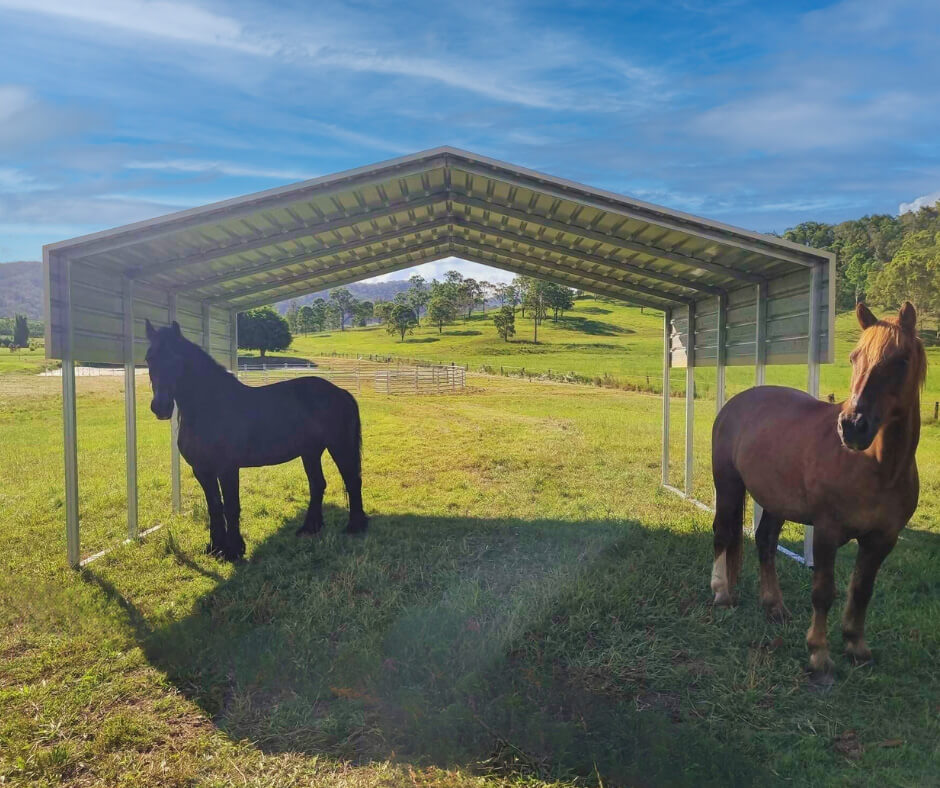
Livestock shelters focus on animal comfort and adequate space per head. Horses typically need more space than cattle, whilst sheep and alpacas require less. Calculate your space needs based on animal numbers and sizes, then factor in feeding equipment or storage.
Agricultural equipment varies widely in dimensions. Compact tractors differ dramatically from wide-body models, whilst implements add substantial width. Tractors and harvesters vary significantly in width, and that’s before they even add implements. Measure your machinery with all attachments in place.
Commercial operations need to consider forklift turning circles, workshop space, and equipment fleet dimensions. Calculate based on your largest equipment plus circulation space.
Our customisation options
We’ve got a range of widths available to meet your measurements and length customisation in 100mm increments. Height can be customised in 100mm increments up to 4m side height, and our team can provide detailed clearance drawings showing the internal dimensions for you to verify the suitability of your shortlisted sizes during quoting, as advertised widths are not internal clearances.
Ready to work through your sizing decision?
This guide provides considerations for various applications, but you will need to physically measure your actual assets to determine adequate clearance as you’re responsible for measuring assets (including trailers, mirrors, and attachments) and ensuring sufficient clearance.
Ready to discuss your requirements? Get a free quote or contact us today. We’ll provide clearance drawings and help you work through the measurements that matter.